




Geotextiles are indispensablefor modern infrastructure and civil engineering. From roadway foundations to retaining walls and erosion control systems, engineered fabrics provide separation and drainage, enhanced soil behavior, and extended life for constructed systems.
When it comes to choosing nonwoven vs. woven geotextiles, getting the right one for soil stabilization and load-bearing applications makes or breaksreaching long-term performance goals. Both materials serve distinctive roles. Appreciating their key differences helps in achieving predictable, lasting results.
Table of Contents
What Are Geotextiles?
Geotextiles are permeable technical fabrics used to improve soil stability, provide reinforcement, or facilitate water movement in civil and environmental construction. They act as a separation layer between soil, aggregate, or other substances and prevent or control intermixing fluid flow.
These materials generally fall into two manufacturing categories:
Woven Geotextiles
Woven geotextiles are made by interlacing high-strength polymer yarns (commonly polypropylene or polyester) in a consistent warp-and-weft pattern. The result is a stable fabric with very low elongation and high tensile strength.
Typical production methods use slit-film tapes or monofilament filaments woven tightly to form a durable grid structure. This gives woven fabrics their superior mechanical properties and load distribution characteristics.
Nonwoven Geotextiles
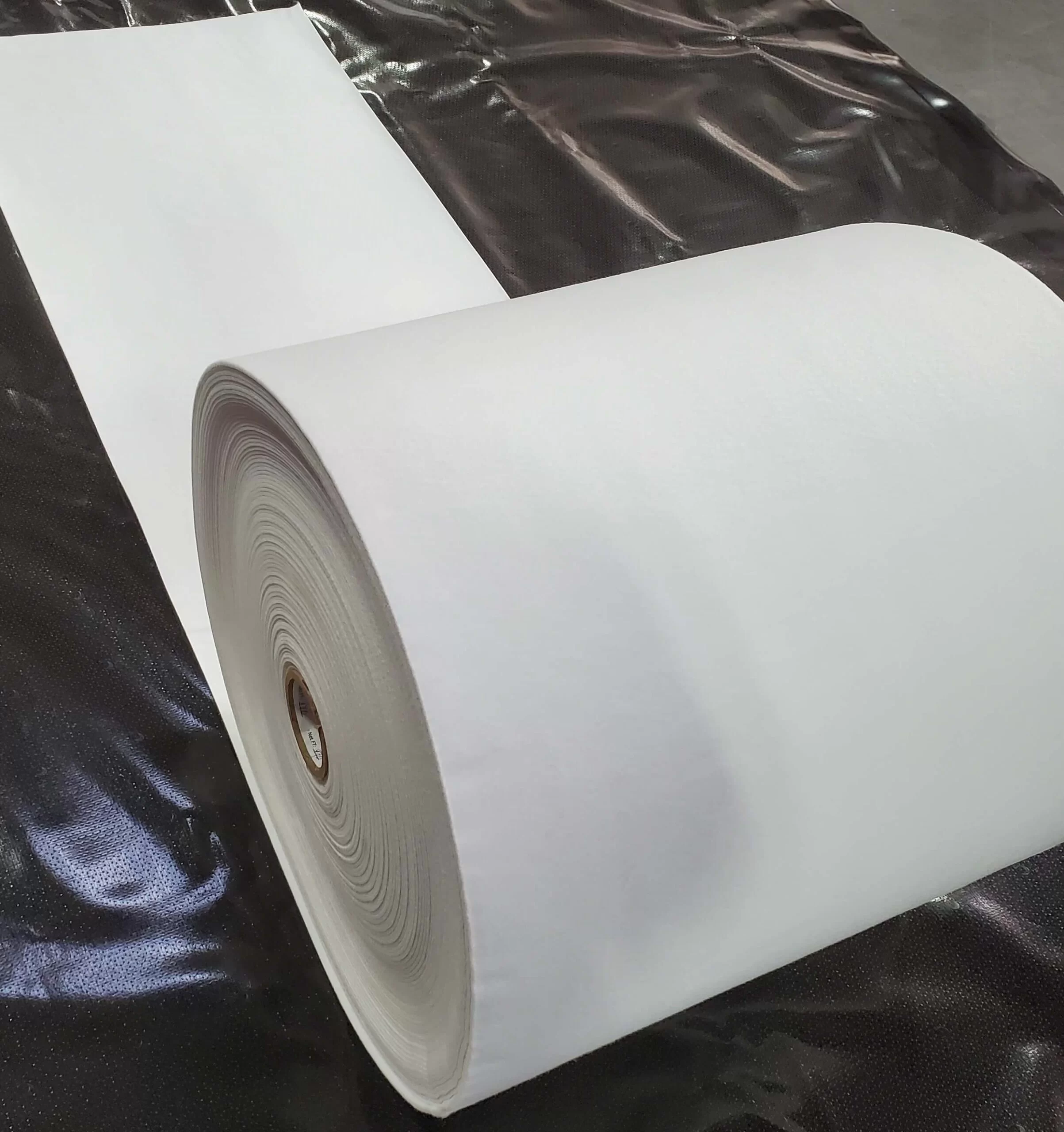
Nonwoven geotextiles are produced by bonding together continuous or staple synthetic fibers using mechanical, thermal, or chemical methods. The random orientation of fibers creates a felt-like structure that is highly permeable and well-suited for filtration and drainage.
They may be needle-punched, heat-bonded, or resin-bonded, depending on end-use demands for strength and flow properties.
Key Performance Differences
When evaluating nonwoven vs. woven geotextiles for a project, several measurable parameters define suitability:
Performance Metric |
Woven Geotextiles |
Nonwoven Geotextiles |
Tensile Strength |
High |
Moderate |
Elongation |
Low (5–25%) |
High (40–60%) |
Puncture Resistance |
Excellent |
Good to excellent (depends on thickness) |
Filtration / Permeability |
Limited – low flow rate |
High – ideal for drainage |
Stiffness / Dimensional Stability |
High |
Moderate |
Cost Efficiency |
Generally lower per strength rating |
Slightly higher for equivalent strength |
Installation/Handling |
Rigid, less conforming |
Flexible, easily shaped to subgrades |
Bottom line:
- Woven geotextiles shine in soil separation and load support.
- Nonwovens excel in filtration, drainage, and hydraulic applications.
Understanding Soil Stabilization
Soil stabilization involves reinforcing or modifying in-situ soils to improve load-bearing capacity, reduce deformation, and prevent interlayer mixing between aggregates and subgrade.
Geotextiles play three fundamental roles in stabilization systems:
- Separation – Preventing aggregate and soil migration.
- Reinforcement – Increasing tensile capacity of the soil structure.
- Filtration and Drainage – Allowing controlled fluid flow while retaining fine particles.
Choosing between woven and nonwoven types depends heavily on which of these roles dominates in your design needs.
Application-by-Application Comparison
Roadway and Base Stabilization
For highways, temporary roads, and unpaved access routes, woven geotextiles are typically preferred. Their high tensile modulus distributes vehicle loads, limits rutting, and prevents base material loss into soft subgrades.
Use woven geotextiles when:
- Subgrade soils have low CBR values or high moisture.
- The design prioritizes load distribution and reduced deformation.
- Minimal permeability is acceptable because drainage is provided elsewhere.
Retaining Walls and Embankments
Retaining wall applications benefit from woven fabrics with predictable elongation and long-term strength retention. They serve as reinforcement behind facing units, maintaining wall integrity under lateral loads.
Soft Soils and Subsurface Reinforcement
For projects involving compressible or saturated soils, nonwoven geotextiles often perform better because they allow dissipation of pore water pressure, improving consolidation and stability over time.
Drainage and Filtration Layers
In French drains, subsurface water collection systems, and filtration trenches, nonwoven geotextiles are ideal. Their high permeability allows water to pass through while retaining fines, reducing clogging and maintaining flow rates.
Erosion Control
On slopes or shorelines, nonwoven geotextiles often serve as underlayers for riprap and revetment systems. Their filtration capacity prevents soil washout while maintaining contact between rock and subgrade.
In higher structural containment needs, such as reinforced embankments, woven geotextiles provide the required strength to support heavy loads.
Testing Standards and Specifications
Designers and engineers rely on standardized testing to ensure geotextiles meet specific performance criteria. Some of the most common methods include:
- ASTM D4595 – Tensile properties of geotextiles by wide-width strip method.
- ASTM D4491 – Water permeability (flow rate) of geotextiles.
- ASTM D4833 – Index puncture resistance test.
- AASHTO M288 – Roadway construction standard specifying acceptable geotextile classes by application.
For DOT or other agency projects, these specifications define performance benchmarks for separation, stabilization, and filtration materials. (Reference: ASTM International and AASHTO).
E Square’s Approach to Engineered Geotextiles
At E Square we manufacture both woven and nonwoven geotextiles designed for consistent, verifiable performance across civil, environmental, and industrial projects.
Our products are engineered to meet stringent ASTM and AASHTO standards while delivering value through superior quality control and technical customization.
E Square’s geotextile solutions are designed with:
- Precision-controlled polymer selection for predictable tensile and hydraulic properties.
- Tight specification tolerances for roll uniformity and consistent mass per area performance.
- Custom-engineered combinations for filtration, reinforcement, and drainage under varied field conditions.
- Durability testing and traceability systems ensuring repeatable field performance over time.
Whether used beneath a highway, landfill cap, or containment berm, E² geotextiles are built to stabilize, separate, and protect for the long haul.
Choosing the Right Geotextile
To simplify material selection, use this quick engineering guide:
Use Woven Geotextiles When:
- You need high tensile strength and load-bearing support.
- Soil separation and reinforcement are primary functions.
- The project involves road bases, embankments, or retaining walls with minimal water flow requirements.
Use Nonwoven Geotextiles When:
- Drainage and filtration are required along with stabilization.
- Subgrade conditions include moisture, fines, or hydrostatic pressure.
- The application involves erosion control, underdrains, or shoreline protection systems.
Ultimately, performance should not be determined by fabric type alone but by the interaction between the geotextile, soil type, and hydraulic environment.
Match the Fabric to the Function
The question of nonwoven vs. woven geotextiles comes down to application priorities. Wovens deliver unmatched reinforcement and soil separation under load, while nonwovens excel at filtration, permeability, and adaptability in wet, soft, or variable sites.
By selecting the right geotextile system engineered for the site’s soil conditions and performance goals, engineers can build stability into the foundation—literally. At E Square we provide the materials, testing confidence, and manufacturing reliability needed for lasting ground support.